
A CIBIL Score Calculator helps you estimate your likely CIBIL Score based on your credit behavior and financial habits. Your CIBIL Score plays an important role whenever you apply for a personal loan, home loan, credit card, or car loan. Banks and NBFCs use this score to evaluate your creditworthiness before approving your application.
Although there is no official tool that can calculate your exact CIBIL Score without your complete credit history, a CIBIL Score Calculator provides an estimated score using factors such as repayment history, credit utilization, loan accounts, and payment behavior. This guide explains how a CIBIL Score Calculator works, what factors affect your score, and how you can improve it.
This calculator is useful for:
✔ Personal Loan Applicants
✔ Home Loan Applicants
✔ Credit Card Users
✔ First-Time Borrowers
✔ Business Owners
✔ Students Planning Future Credit
CIBIL Score Calculator
30%What is a CIBIL Score Calculator?
A CIBIL Score Calculator is an online estimation tool that predicts your credit score based on your financial information. For example, it considers your loan repayment history, credit card usage, active loans, credit inquiries, credit utilization ratio, and the length of your credit history. However, the calculator provides only an estimated score, not your official CIBIL Score.
- Loan repayment history
- Credit card usage
- Number of active loans
- Credit inquiries
- Credit utilization ratio
- Length of credit history
The calculator provides an estimated score, not your official CIBIL Score.
What is a CIBIL Score?
A CIBIL Score is a three-digit number ranging from 300 to 900. It reflects your repayment behavior and financial discipline. Generally, a higher score increases your chances of loan approval, whereas a lower score indicates higher risk for lenders.
It reflects your repayment behavior and financial discipline.
Generally:
- Higher score = Better chances of loan approval.
- Lower score = Higher risk for lenders.
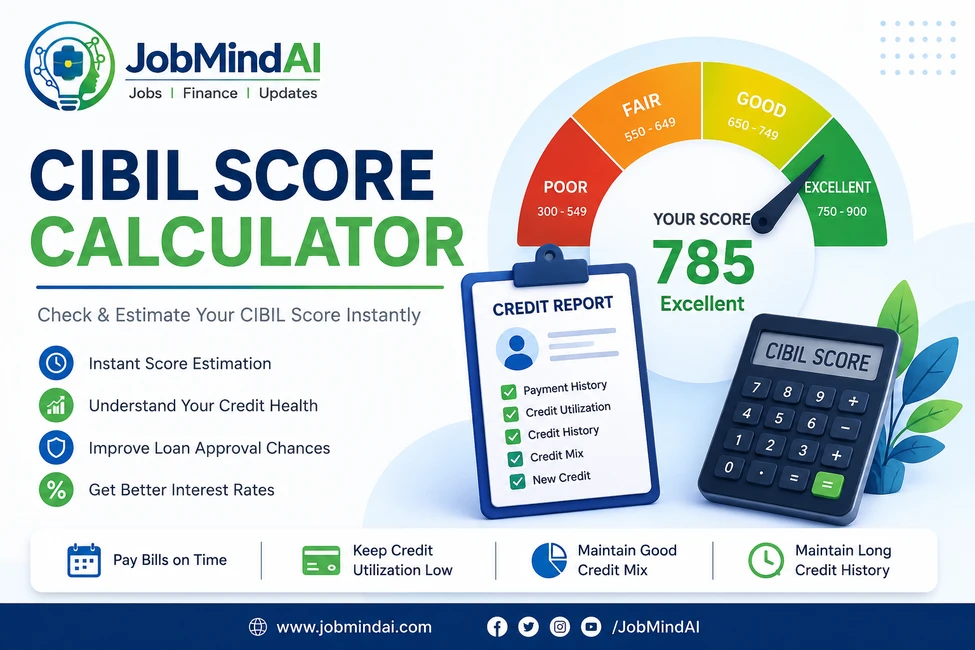
CIBIL Score Range
| CIBIL Score | Rating | Loan Approval Chance |
|---|---|---|
| 300–549 | Poor | Very Low |
| 550–649 | Fair | Low |
| 650–749 | Good | Moderate |
| 750–900 | Excellent | Very High |
How Does a CIBIL Score Calculator Work?
A CIBIL Score Calculator estimates your score using several financial factors. First, it analyzes your payment history. Next, it evaluates your credit utilization ratio. Additionally, it considers your credit mix, loan applications, and the length of your credit history. As a result, it provides an estimated credit score.
1. Payment History
Making EMI and credit card payments on time positively affects your estimated score.
2. Credit Utilization
Using less than 30% of your credit limit helps maintain a healthy score.
3. Credit Mix
Having both secured and unsecured loans improves your credit profile.
4. Loan Applications
Applying for multiple loans within a short period can reduce your estimated score.
5. Credit History
A longer credit history generally increases your score.
How to Use a CIBIL Score Calculator
Follow these simple steps:
- Enter your age.
- Select your monthly income.
- Enter your existing loan details.
- Provide your credit card usage.
- Mention your repayment history.
- Submit the information.
- View your estimated CIBIL Score.
Factors That Affect Your CIBIL Score
Several factors affect your CIBIL Score. First, paying EMIs and credit card bills on time improves your score. Moreover, keeping your credit utilization below 30% helps maintain a healthy credit profile. Additionally, maintaining a balanced mix of secured and unsecured loans is beneficial. However, too many hard inquiries and high outstanding debt can lower your score.
Payment History
First of all, paying your EMIs and credit card bills on time contributes significantly to your CIBIL Score. Therefore, maintaining a consistent repayment history helps build a strong credit profile.
Credit Utilization Ratio
Additionally, you should keep your credit utilization below 30% of your total credit limit. As a result, lenders may view you as a responsible borrower.
Loan Mix
Moreover, maintaining a balanced mix of secured and unsecured loans improves your credit profile. This also demonstrates your ability to manage different types of credit responsibly.
Hard Inquiries
However, applying for multiple loans or credit cards within a short period can reduce your CIBIL Score. Therefore, apply for new credit only when it is genuinely needed.
Outstanding Debt
Finally, carrying a high amount of outstanding debt can negatively impact your CIBIL Score. Hence, reducing your existing debt and paying outstanding balances on time can improve your overall credit health.
How to Improve Your CIBIL Score
Improving your CIBIL Score requires consistent financial discipline. First, pay all EMIs and credit card bills on time. Furthermore, keep your credit card usage below 30% of your available limit. In addition, avoid applying for multiple loans within a short period. Finally, monitor your credit report regularly and correct any errors if necessary.
Pay Bills on Time
First, always pay your EMI and credit card bills on time. This is because timely payments have the biggest positive impact on your CIBIL Score.
Reduce Credit Card Usage
Next, try to keep your credit card usage below 30% of your available credit limit. As a result, lenders are more likely to consider you a responsible borrower.
Avoid Multiple Loan Applications
Furthermore, apply for loans or credit cards only when necessary. Otherwise, multiple hard inquiries within a short period may reduce your CIBIL Score.
Clear Outstanding Loans
In addition, reduce your existing debt whenever possible. Consequently, a lower outstanding balance can improve your credit profile over time.
Monitor Your Credit Report
Finally, check your credit report regularly for errors or unauthorized accounts. If you find any mistakes, report them immediately to the credit bureau so they can be corrected.
Benefits of a Good CIBIL Score
A high CIBIL Score offers several benefits. For example, you may receive faster loan approvals, lower interest rates, better credit card offers, and higher loan eligibility. Moreover, many lenders offer better loan terms to applicants with excellent credit scores.
- Faster loan approval
- Better credit card offers
- Lower interest rates
- Higher loan eligibility
- Easier home loan approval
- Better negotiation power with lenders
Why is a 750+ CIBIL Score Considered Good?
Most banks prefer borrowers with a CIBIL Score above 750 because they are considered financially responsible. As a result, they usually enjoy higher approval chances, lower processing time, better loan terms, and increased credit limits.
Benefits include:
- Higher approval chances
- Lower processing time
- Better loan terms
- Increased credit limits
Common Mistakes That Lower Your CIBIL Score
Several common mistakes can lower your CIBIL Score.
For example,
- missing EMI payments,
- paying credit card bills late,
- maxing out credit cards,
- applying for multiple loans simultaneously may negatively affect your score.
- Therefore, it is important to avoid these habits.
Advantages of Using a CIBIL Score Calculator
- Free to use
- Instant estimated score
- Easy to understand
- Helps improve credit habits
- Useful before loan applications
Limitations
- Not your official CIBIL Score
- Results are estimates
- Credit bureau data is not used
Is a CIBIL Score Calculator Accurate?
However, a CIBIL Score Calculator provides only an estimated score, not your official CIBIL Score. Your official score, on the other hand, is calculated by the credit bureau using your complete credit history. Therefore, use the calculator to understand your financial position and identify areas for improvement. However, always check your official credit report to know your exact CIBIL Score.
Official Resources
- TransUnion CIBIL (Official Website)
- Reserve Bank of India (RBI)
- Credit Information Companies (RBI Information)
- SBI Personal Loans
Frequently Asked Questions (FAQs)
What is the minimum CIBIL Score for a personal loan?
Most banks prefer a CIBIL Score of 700 or above for personal loan approval. However, a score of 750 or higher generally offers the best approval chances and may also help you secure better loan terms.
Can I calculate my exact CIBIL Score?
No. You cannot calculate your exact CIBIL Score using an estimation tool. Instead, only the official credit bureau can generate your exact score based on your complete credit history.
Does checking my CIBIL Score reduce it?
No. Checking your own CIBIL Score is considered a soft inquiry. Therefore, it does not affect your credit score in any way.
How often should I check my CIBIL Score?
It is generally recommended to check your CIBIL Score every 3–6 months. This helps you monitor your credit health and identify any errors or suspicious activity at an early stage.
Is a CIBIL Score Calculator free?
Yes, many websites provide a free CIBIL Score Calculator to estimate your score. However, these tools provide only an estimated score, while your official CIBIL Score is available through authorized credit bureaus.
You May Also Like
- How to Improve CIBIL Score Fast
- Best Personal Loans in India
- Best Credit Cards in India
- The Future of Digital Banking in India
Conclusion
Overall, a CIBIL Score Calculator is a useful tool for estimating your credit score and understanding how your financial habits may affect loan eligibility. Although it cannot provide your exact CIBIL Score, it offers valuable insights into areas that need improvement. Therefore, maintaining timely payments, keeping credit utilization low, and monitoring your credit report regularly can help you build a strong credit profile. As a result, you can improve your chances of getting loans and credit cards on favorable terms.
Written by JobMindAI Editorial Team
Last Updated: July 2026