
Introduction
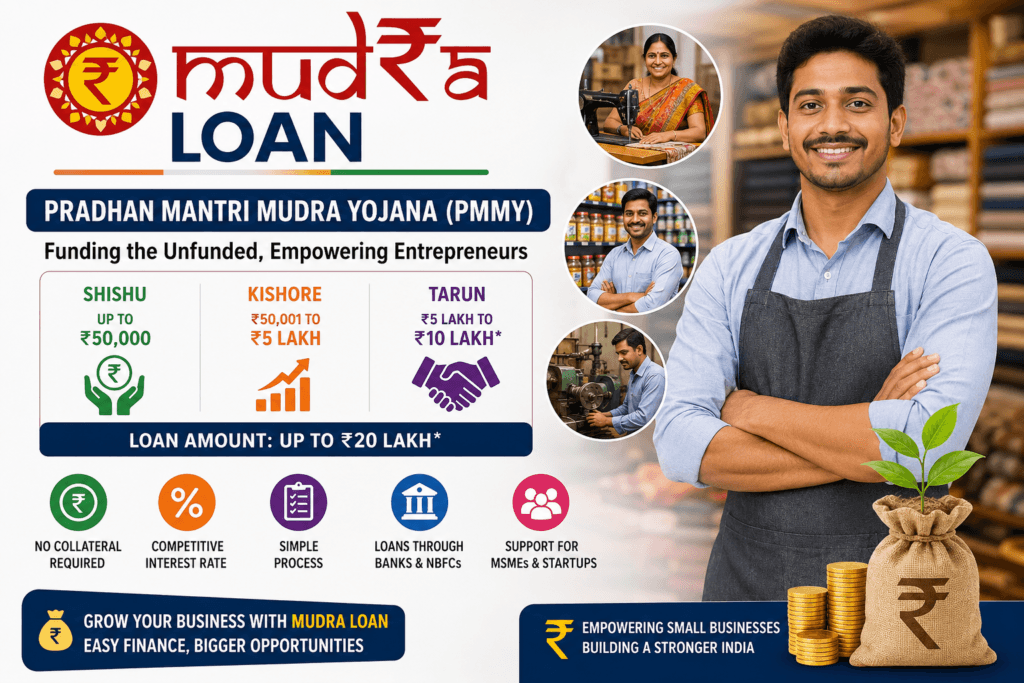
Starting a small business requires determination, planning, and adequate financial support. However, many aspiring entrepreneurs struggle to arrange funds because they lack collateral or a strong credit history. Therefore, the Government of India introduced the Pradhan Mantri Mudra Loan (PMMY) to provide easy and affordable business loans to micro and small enterprises. As a result, millions of individuals have been able to start or expand their businesses without facing major financial barriers.
The Mudra Loan Scheme has become one of India’s most successful government-backed financial initiatives. Moreover, it supports shopkeepers, traders, manufacturers, service providers, startups, artisans, and self-employed professionals. In addition, borrowers can access loans through banks, Small Finance Banks, NBFCs, and Micro Finance Institutions (MFIs). Consequently, entrepreneurs can obtain financial assistance from multiple lending institutions under a single government scheme.
Whether you want to open a retail shop, expand an existing business, purchase machinery, or start a new service-based enterprise, the Mudra Loan Scheme offers flexible financing options. Furthermore, the scheme encourages entrepreneurship among women, young professionals, and first-time business owners. Therefore, Mudra Loan continues to play an important role in promoting employment generation and economic growth across India.
What is Mudra Loan?
A Mudra Loan is a business loan provided under the Pradhan Mantri Mudra Yojana (PMMY), which was launched by the Government of India to support micro and small businesses. Unlike traditional business loans, Mudra Loans are specially designed for non-corporate and non-farm enterprises. As a result, small entrepreneurs can obtain financial support without complicated borrowing procedures.
The scheme provides loans of up to ₹20 lakh (as per the latest PMMY guidelines). Moreover, borrowers can use the loan amount for purchasing equipment, expanding business operations, buying working capital, or establishing a new enterprise. Consequently, businesses receive the financial support needed for long-term growth.
PMMY Full Form
The full form of PMMY is Pradhan Mantri Mudra Yojana.
Moreover, the scheme is managed through MUDRA (Micro Units Development and Refinance Agency) Ltd. In addition, the Government works with banks and financial institutions to ensure eligible applicants receive timely financial assistance. Therefore, borrowers can apply through various authorized lenders across India.
Objectives of Mudra Loan Scheme
The Mudra Loan Scheme was introduced with several important objectives. First, it aims to promote entrepreneurship among small business owners. Secondly, it provides financial support to individuals who may not qualify for large commercial loans. Furthermore, the scheme encourages self-employment and supports sustainable business growth.
The major objectives include:
- Promote self-employment opportunities.
- Support micro and small businesses.
- Encourage entrepreneurship among youth.
- Strengthen the MSME sector.
- Increase financial inclusion.
- Generate employment across rural and urban India.
- Improve access to formal credit.
- Reduce dependence on informal money lenders.
- Encourage women entrepreneurs.
- Promote economic development.
As a result, the scheme contributes significantly to India’s startup ecosystem and local business development.
Key Highlights of Mudra Loan 2026
| Particular | Details |
|---|---|
| Scheme Name | Pradhan Mantri Mudra Yojana (PMMY) |
| Popular Name | Mudra Loan |
| Launched By | Government of India |
| Maximum Loan Amount | Up to ₹20 Lakh |
| Loan Purpose | Business & MSME Finance |
| Collateral | Usually Not Required (subject to lender policy) |
| Beneficiaries | Small Businesses & Entrepreneurs |
| Application Mode | Online & Offline |
| Participating Institutions | Banks, NBFCs, MFIs & Small Finance Banks |
Furthermore, borrowers can choose a suitable lender depending on their location and business requirements. Therefore, accessing finance becomes more convenient for eligible applicants.
Key Features of Mudra Loan
The Mudra Loan Scheme offers several unique features that distinguish it from ordinary business loans. Moreover, these features make it suitable for first-time entrepreneurs as well as existing small business owners.
1. Government-Backed Business Loan
Mudra Loan is supported under the Government’s PMMY initiative. Therefore, it is specifically designed to promote entrepreneurship among small businesses.
2. No Collateral Requirement
Most Mudra Loans do not require collateral, subject to the lender’s policies and applicable regulations. Consequently, eligible borrowers can apply even if they do not own valuable assets.
3. Flexible Loan Amount
Applicants can obtain financial assistance according to their business requirements. In addition, different loan categories help businesses at various stages of growth.
4. Wide Availability
Mudra Loans are available through public sector banks, private banks, Regional Rural Banks (RRBs), Small Finance Banks, NBFCs, and MFIs. As a result, borrowers have multiple financing options.
5. Supports Multiple Business Sectors
The scheme supports manufacturing, trading, agriculture-related allied activities, transportation, food processing, retail businesses, and service enterprises. Therefore, entrepreneurs from different industries can benefit from the scheme.
6. Encourages Women Entrepreneurs
Women entrepreneurs are encouraged to apply under the scheme. Moreover, many lenders offer special support and promotional schemes for eligible women borrowers.
7. Simple Application Process
Applicants can submit their applications online or offline. Finally, after successful verification and approval, the sanctioned loan amount is disbursed according to the lender’s process.
Benefits of Mudra Loan
The Mudra Loan Scheme provides several financial and business advantages. First, it improves access to formal credit for small entrepreneurs. Moreover, it helps businesses expand without depending on expensive informal borrowing.
Major benefits include:
- Easy access to business finance.
- No collateral for many eligible loans.
- Government-supported financing.
- Flexible repayment options.
- Loan for new and existing businesses.
- Supports women entrepreneurs.
- Encourages startup growth.
- Improves employment generation.
- Available across India.
- Quick application process through participating lenders.
Overall, the Mudra Loan Scheme has become one of India’s most trusted business financing programmes. Therefore, entrepreneurs planning to start or expand a small business in 2026 should consider this scheme as a reliable funding option.
Types of Mudra Loan
The Pradhan Mantri Mudra Yojana (PMMY) offers different loan categories based on the stage and financial needs of a business. Therefore, applicants can choose the most suitable loan type according to their business requirements. Moreover, each category is designed to support businesses from the startup stage to expansion.
1. Shishu Loan
The Shishu Loan is designed for entrepreneurs who are starting a new business or require a small amount of capital. Generally, it is suitable for first-time entrepreneurs.
- Loan Amount: Up to ₹50,000
- Suitable For: New businesses and startups
- Best For: Small shops, home-based businesses, street vendors, and self-employed individuals
As a result, beginners can establish their businesses with minimum financial pressure.
2. Kishore Loan
The Kishore Loan is intended for businesses that have already started operations and require additional funds for expansion. Moreover, it helps entrepreneurs improve their production capacity or business infrastructure.
- Loan Amount: ₹50,001 to ₹5 Lakh
- Suitable For: Existing small businesses
- Best For: Business expansion, equipment purchase, and working capital
Consequently, entrepreneurs can scale their businesses without facing major financial challenges.
3. Tarun Loan
The Tarun Loan is suitable for established businesses planning significant expansion. Furthermore, this category provides higher financial assistance to support long-term business growth.
- Loan Amount: ₹5 Lakh to ₹10 Lakh
4. Tarun Plus Loan
To encourage growing MSMEs, the Government has also introduced the Tarun Plus category under updated PMMY guidelines.
- Loan Amount: Above ₹10 Lakh and up to ₹20 Lakh (subject to current scheme guidelines and lender approval)
Therefore, entrepreneurs with larger expansion plans may benefit from enhanced financial support under the latest provisions.
Mudra Loan Amount
Mudra Loans are available according to the selected loan category.
| Loan Category | Loan Amount |
|---|---|
| Shishu | Up to ₹50,000 |
| Kishore | ₹50,001 – ₹5 Lakh |
| Tarun | ₹5 Lakh – ₹10 Lakh |
| Tarun Plus | Above ₹10 Lakh – ₹20 Lakh |
Moreover, the sanctioned loan amount depends on the applicant’s business profile, repayment capacity, project feasibility, and the lending institution’s assessment. Therefore, applicants should prepare a realistic business plan before applying.
Mudra Loan Interest Rate
There is no single fixed interest rate under the Mudra Loan Scheme. Instead, the interest rate is decided by the lending bank or financial institution according to applicable RBI guidelines and the applicant’s profile.
The interest rate generally depends on:
- Applicant’s credit profile
- Business experience
- Loan amount
- Business category
- Lender’s internal policy
- Market conditions
Therefore, applicants should compare interest rates offered by different banks before submitting an application. In addition, comparing processing charges and repayment terms can help reduce the overall borrowing cost.
Eligibility Criteria for Mudra Loan
Applicants must satisfy certain eligibility conditions before applying. Therefore, checking the eligibility requirements in advance is highly recommended.
Eligible applicants include:
- Individual Entrepreneurs
- Proprietorship Firms
- Partnership Firms
- Small Manufacturing Units
- Service Providers
- Shopkeepers
- Retail Traders
- Artisans
- MSMEs
- Women Entrepreneurs
- Self-employed Professionals
- Food Processing Units
- Transport Operators
Furthermore, applicants should have a genuine business purpose and the ability to repay the loan. Consequently, lenders evaluate both the business proposal and the applicant’s financial profile during the approval process.
Documents Required
Applicants should collect all required documents before applying. First, verify that every document is valid. Next, ensure that the details match the application form. Finally, upload clear copies to avoid delays.
Required documents include:
- Aadhaar Card
- PAN Card
- Passport-size Photograph
- Address Proof
- Business Address Proof
- Bank Statement
- Business Registration (if applicable)
- GST Registration (if applicable)
- Income Proof (where required)
- Business Plan or Project Report
- Udyam Registration (if available)
Moreover, lenders may request additional documents depending on the loan amount and business category.
Eligible Business Activities
Mudra Loans support a wide range of income-generating activities. Therefore, entrepreneurs from different sectors can apply if they meet the eligibility criteria.
Eligible businesses include:
- Retail Shops
- Grocery Stores
- Garment Shops
- Food Processing Units
- Dairy Farming
- Poultry Farming
- Beauty Parlours
- Salons
- Tailoring Units
- Computer Centers
- Mobile Repair Shops
- Automobile Repair Workshops
- Printing Businesses
- Restaurants
- Cafes
- Travel Agencies
- Transport Services
- E-commerce Businesses
- Handicrafts
- Small Manufacturing Units
As a result, the scheme promotes entrepreneurship across both rural and urban India.
Ineligible Business Activities
Although Mudra Loans support many businesses, some activities are not eligible. Therefore, applicants should verify the latest lender guidelines before applying.
Generally, the following are not eligible:
- Speculative Activities
- Illegal Businesses
- Businesses Prohibited by Law
- Activities Restricted under Applicable Government Regulations
Consequently, selecting an eligible business activity is essential for successful loan approval.
Processing Fee
The processing fee varies from one lender to another. Moreover, many banks offer low or nil processing charges for eligible Mudra Loan categories. Therefore, applicants should compare lender policies before making a final decision.
Repayment Period
Mudra Loans offer flexible repayment options. Generally, the repayment tenure depends on the loan amount, business cash flow, and lender policy.
- Flexible EMI options
- Repayment tenure decided by the lender
- Early repayment may be available as per lender rules
Furthermore, timely repayment helps maintain a good credit history. As a result, borrowers may find it easier to obtain additional business finance in the future.
Why Choose Mudra Loan?
The Mudra Loan Scheme remains one of India’s most popular financing options for small businesses. Moreover, it supports both new and existing enterprises by providing accessible business credit through multiple lenders.
Key advantages include:
- Government-supported business finance
- Loan categories for different business stages
- Wide network of participating banks and NBFCs
- Flexible repayment options
- Support for MSMEs and self-employed individuals
- Encouragement for women entrepreneurs
- Suitable for both rural and urban businesses
Overall, Mudra Loan 2026 offers a practical financing solution for entrepreneurs who want to start, strengthen, or expand their businesses with institutional financial support.
How to Apply for Mudra Loan Online
Applying for a Mudra Loan is a simple process. Moreover, most banks and financial institutions allow applicants to submit their applications online or offline. Therefore, entrepreneurs can choose the method that is most convenient for them.
Step 1: Choose a Participating Bank
First, select a bank, NBFC, Small Finance Bank, or Micro Finance Institution (MFI) that offers Mudra Loans. After that, visit the branch or the lender’s official website to check the latest loan guidelines.
Step 2: Fill Out the Application Form
Next, complete the Mudra Loan application form carefully. In addition, ensure that all personal, business, and financial details are accurate before submitting the form.
Step 3: Upload or Submit Documents
Then, attach all the required documents, including identity proof, address proof, business documents, and photographs. Furthermore, upload clear scanned copies if you are applying online.
Step 4: Business Verification
After that, the bank verifies your business details, project report, repayment capacity, and submitted documents. Meanwhile, the lender may request additional information if required.
Step 5: Loan Approval
Once the verification is completed successfully, the lender evaluates your application. If everything meets the eligibility criteria, the loan is approved.
Step 6: Loan Disbursement
Finally, the sanctioned loan amount is credited to your bank account according to the lender’s disbursement process. Consequently, you can start or expand your business using the approved funds.
You Also Like
- PMEGP (Prime Minister Employment Generation Programme): Complete Guide
- SBI Home Loan 2026
- Personal Loan Apps in India 2026
Banks Offering Mudra Loan
Mudra Loans are available through various banks and financial institutions across India. Therefore, applicants can choose the lender that best suits their business needs.
Participating lenders include:
- State Bank of India (SBI)
- Punjab National Bank (PNB)
- Bank of Baroda
- Canara Bank
- Union Bank of India
- Indian Bank
- Bank of India
- UCO Bank
- Indian Overseas Bank
- Central Bank of India
- Punjab & Sind Bank
- Regional Rural Banks (RRBs)
- Small Finance Banks
- Eligible NBFCs
- Micro Finance Institutions (MFIs)
Moreover, comparing interest rates, processing fees, and repayment options before applying can help you make a better financial decision.
Mudra Loan Approval Process
After submitting the application, the lender follows a structured approval process. Initially, your documents are verified. Next, the bank evaluates your business proposal and repayment capacity. Thereafter, the lender may conduct additional verification if necessary. Finally, the application is either approved or rejected based on the assessment.
The approval process generally includes:
- Application Review
- Document Verification
- Credit Assessment
- Business Evaluation
- Loan Sanction
- Loan Disbursement
Therefore, submitting accurate information can significantly improve your approval chances.
Mudra Loan EMI & Repayment
The repayment schedule depends on the sanctioned loan amount and the lender’s policy. Generally, borrowers repay the loan through monthly EMIs.
Important repayment features include:
- Flexible repayment tenure
- Monthly EMI facility
- Competitive interest rates
- Early repayment option (subject to lender policy)
- Digital repayment through banking channels
Furthermore, paying EMIs on time helps maintain a healthy credit score. As a result, borrowers may become eligible for higher loan amounts in the future.
Tips to Increase Mudra Loan Approval Chances
Although the application process is straightforward, applicants should follow certain best practices. Consequently, these steps can improve the probability of loan approval.
- Prepare a detailed business plan.
- Submit complete and accurate documents.
- Maintain a good credit history.
- Clearly explain the purpose of the loan.
- Estimate the project cost realistically.
- Choose the appropriate Mudra Loan category.
- Respond promptly to bank queries.
- Maintain an active bank account with regular transactions.
Moreover, honest financial information builds confidence with the lender. Therefore, avoid providing incorrect or misleading details.
Common Reasons for Mudra Loan Rejection
Some applications are rejected because of avoidable mistakes. However, understanding these reasons in advance can help applicants submit a stronger application.
Common reasons include:
- Incomplete application form
- Missing or invalid documents
- Poor credit history
- Weak business proposal
- Ineligible business activity
- Incorrect financial information
- Existing loan repayment issues
- Failure to meet lender eligibility criteria
Therefore, review every section of the application carefully before submission. In addition, verify that all supporting documents are accurate and up to date.
Why Should You Choose Mudra Loan?
Mudra Loan is one of India’s most trusted government-supported business financing schemes. Moreover, it enables entrepreneurs to establish or expand micro and small enterprises without facing the challenges associated with large commercial loans.
Major advantages include:
- Government-supported business financing
- Multiple loan categories
- Flexible repayment options
- Wide network of participating lenders
- Support for startups and MSMEs
- Encourages women entrepreneurship
- Helps create employment opportunities
- Available across India
Overall, the scheme provides a practical financing solution for entrepreneurs who want to grow their businesses sustainably.
Conclusion
The Pradhan Mantri Mudra Yojana (PMMY) has transformed access to finance for millions of small entrepreneurs across India. Moreover, the scheme supports startups, shopkeepers, manufacturers, traders, and service providers by offering business loans through banks, NBFCs, and other participating financial institutions.
Whether you are planning to launch a new business or expand an existing enterprise, Mudra Loan offers flexible funding options that suit different business stages. Furthermore, choosing the right loan category, preparing a strong business proposal, and submitting complete documents can significantly improve your approval chances. Therefore, applicants should carefully compare lenders, understand the loan terms, and follow the official application process.
Finally, if you are looking for a government-supported business loan in 2026, the Mudra Loan Scheme remains one of the best options for funding your entrepreneurial journey and contributing to India’s growing MSME sector.
Frequently Asked Questions (FAQs)
1. What is Mudra Loan?
Mudra Loan is a government-supported business loan provided under the Pradhan Mantri Mudra Yojana (PMMY) for eligible micro and small enterprises.
2. What is the maximum Mudra Loan amount?
Eligible applicants can obtain financial assistance according to the applicable Mudra Loan category and current PMMY guidelines.
3. Who can apply for Mudra Loan?
Individual entrepreneurs, proprietorship firms, partnership firms, MSMEs, traders, shopkeepers, service providers, artisans, and eligible business owners can apply.
4. Is collateral required for Mudra Loan?
Many Mudra Loans are offered without collateral, although the final decision depends on the lender’s policy and applicable regulations.
5. Can I apply for Mudra Loan online?
Yes. Moreover, many participating banks and financial institutions provide both online and offline application facilities.
6. Which banks offer Mudra Loans?
Public sector banks, private banks, Regional Rural Banks (RRBs), Small Finance Banks, eligible NBFCs, and MFIs participate in the Mudra Loan Scheme.
7. Can women entrepreneurs apply?
Yes. In fact, women entrepreneurs are encouraged to apply under the Mudra Loan Scheme, and several lenders offer dedicated support for eligible applicants.
8. What documents are required?
Generally, applicants need Aadhaar Card, PAN Card, address proof, photographs, bank details, business-related documents, and a project report where applicable.