
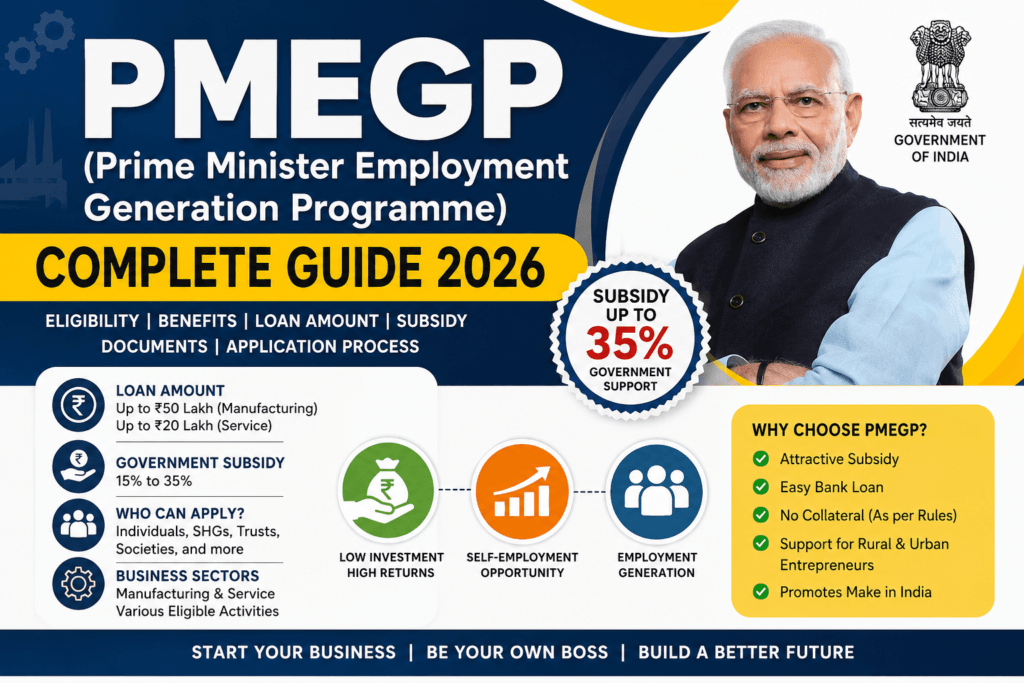
What is PMEGP (Prime Minister Employment Generation Programme)?
Starting a business requires proper planning, financial support, and the right government assistance. However, many aspiring entrepreneurs struggle to arrange sufficient funds because they do not have collateral or a strong financial background. Therefore, the Government of India introduced the PMEGP Scheme 2026 to encourage self-employment and support new business ventures.
The Prime Minister Employment Generation Programme (PMEGP) is a flagship credit-linked subsidy scheme launched by the Government of India. Moreover, the scheme aims to help unemployed youth, artisans, skilled workers, women entrepreneurs, and other eligible individuals establish new micro-enterprises across the country. As a result, thousands of entrepreneurs receive financial assistance to start manufacturing and service businesses every year.
Unlike traditional business loans, PMEGP provides a government subsidy ranging from 15% to 35%, depending on the applicant’s category and business location. Consequently, entrepreneurs can reduce their initial investment and manage business expenses more effectively. In addition, the scheme promotes inclusive economic growth by encouraging entrepreneurship in both rural and urban areas.
Whether you plan to establish a manufacturing unit or a service-based enterprise, PMEGP offers financial assistance through participating banks. Furthermore, the scheme supports first-time entrepreneurs who have innovative business ideas but limited financial resources. Therefore, PMEGP has become one of the most popular government schemes for promoting self-employment in India.
PMEGP Scheme 2026 Full Form
The full form of PMEGP is Prime Minister Employment Generation Programme. Moreover, it is one of the most successful employment generation schemes introduced by the Government of India for promoting entrepreneurship.
The scheme is implemented by the Khadi and Village Industries Commission (KVIC). Additionally, State Khadi and Village Industries Boards (KVIBs) and District Industries Centres (DICs) also play an important role in implementing the programme. As a result, eligible applicants can access the scheme in almost every district across India.
Unlike wage employment programmes, PMEGP focuses on creating self-employment opportunities. Therefore, beneficiaries become business owners instead of job seekers. Consequently, the scheme contributes to sustainable economic development and long-term employment generation.
Objectives of PMEGP Scheme 2026
The primary objective of PMEGP is to encourage individuals to establish new micro-enterprises. However, the scheme is not limited to providing financial assistance alone. Instead, it aims to develop entrepreneurship and strengthen the country’s small business ecosystem.
The major objectives of PMEGP include:
- Generate sustainable self-employment opportunities.
- Promote entrepreneurship among unemployed youth.
- Encourage rural industrialization.
- Support traditional artisans and skilled workers.
- Reduce unemployment across India.
- Strengthen the MSME sector.
- Increase local manufacturing activities.
- Promote the “Make in India” initiative.
- Improve rural and urban economic development.
Moreover, the scheme helps create additional employment opportunities because every new business often hires workers. As a result, PMEGP contributes to both individual income growth and national economic development.
Key Highlights of PMEGP Scheme 2026
| Particular | Details |
|---|---|
| Scheme Name | Prime Minister Employment Generation Programme (PMEGP) |
| Launched By | Government of India |
| Implementing Agency | KVIC |
| Loan Type | Business Loan |
| Government Subsidy | 15%–35% |
| Manufacturing Project Cost | Up to ₹50 Lakh |
| Service Project Cost | Up to ₹20 Lakh |
| Beneficiaries | New Entrepreneurs |
| Coverage | Rural & Urban Areas |
Furthermore, PMEGP supports eligible entrepreneurs from different social and economic backgrounds. Therefore, it has become one of India’s most trusted government-backed business loan schemes.
Key Features of PMEGP Scheme 2026
PMEGP offers several unique features that make it different from ordinary business loans. Moreover, these features help entrepreneurs establish sustainable businesses with reduced financial risk.
1. Government Subsidy
Eligible applicants receive a government subsidy ranging from 15% to 35%. As a result, entrepreneurs need to arrange less capital from their own resources.
2. Higher Project Cost Limit
The scheme allows project costs of up to ₹50 lakh for manufacturing units and ₹20 lakh for service businesses. Therefore, entrepreneurs can start businesses with better infrastructure and equipment.
3. First-Time Entrepreneurs
PMEGP encourages first-generation entrepreneurs. In addition, applicants do not need prior business ownership experience to apply for eligible projects.
4. Nationwide Availability
The scheme is available throughout India. Consequently, eligible applicants from both villages and cities can benefit from it.
5. Employment Generation
PMEGP not only supports entrepreneurs but also creates employment opportunities for others. As a result, the scheme contributes to overall economic growth.
Benefits of PMEGP Scheme 2026
The Prime Minister Employment Generation Programme (PMEGP) offers several benefits to aspiring entrepreneurs. Moreover, it provides financial assistance that makes starting a new business more affordable. As a result, thousands of individuals establish successful manufacturing and service enterprises every year.
1. Government Subsidy
One of the biggest advantages of PMEGP is the government subsidy. Depending on the applicant’s category and business location, the subsidy ranges from 15% to 35%. Consequently, entrepreneurs need to arrange less capital from their own savings.
2. Easy Access to Business Finance
PMEGP makes it easier to obtain business finance through participating banks. Furthermore, eligible applicants receive bank support for starting new enterprises. Therefore, first-time entrepreneurs can convert their business ideas into reality.
3. Employment Generation
Every successful business creates employment opportunities. As a result, PMEGP not only supports entrepreneurs but also helps reduce unemployment across India.
4. Rural Development
The scheme encourages industries in villages and semi-urban areas. Moreover, it helps reduce migration towards large cities by creating local employment opportunities.
5. Support for Women Entrepreneurs
Women entrepreneurs receive additional support under eligible categories. Therefore, the scheme promotes women-led businesses and strengthens financial independence.
6. Encourages Manufacturing and Service Businesses
PMEGP supports a wide range of manufacturing and service activities. For example, applicants can establish food processing units, tailoring centers, computer institutes, repair shops, printing businesses, and many other enterprises.
7. Promotes Self-Employment
Instead of depending only on jobs, beneficiaries become business owners. Consequently, they contribute to local economic growth while creating additional employment.
Who Can Apply for PMEGP Scheme 2026?
Many people believe that only experienced businessmen can apply. However, this assumption is incorrect. In fact, PMEGP mainly encourages new entrepreneurs who wish to establish their first business.
Eligible applicants include:
- Individual Entrepreneurs
- Self Help Groups (SHGs)
- Registered Trusts
- Cooperative Societies
- Charitable Institutions
- Traditional Artisans
- Women Entrepreneurs
- Ex-Servicemen
- SC Applicants
- ST Applicants
- OBC Applicants
- Minority Communities
- Persons with Disabilities (PwD)
Moreover, applicants from both rural and urban areas are eligible if they satisfy the scheme guidelines.
PMEGP Scheme 2026 Eligibility Criteria
Applicants must satisfy certain eligibility conditions before applying. Therefore, understanding these requirements is essential.
PMEGP Scheme 2026 Minimum Age
Applicants must be 18 years or above. Additionally, they should meet all other eligibility conditions prescribed under the scheme.
PMEGP Scheme 2026 Educational Qualification
For projects above the prescribed cost limit, applicants generally need to have passed at least Class VIII. However, smaller projects may have different requirements under the applicable guidelines.
PMEGP Scheme 2026 New Project Requirement
PMEGP supports only new business projects. Therefore, existing business units are not eligible for financial assistance.
PMEGP Scheme 2026 One Family One Benefit
Only one member of a family can receive assistance for establishing a single project under PMEGP. Consequently, the scheme ensures wider distribution of benefits.
PMEGP Scheme 2026 Aadhaar Requirement
Applicants should possess a valid Aadhaar card for identity verification. In addition, all personal details should match the submitted documents.
Eligible Business Activities
PMEGP supports numerous manufacturing and service businesses. For example, entrepreneurs can choose businesses based on their skills, investment capacity, and local demand.
Manufacturing Businesses
- Furniture Manufacturing
- Bakery Products
- Food Processing Unit
- Garment Manufacturing
- Agarbatti Manufacturing
- Soap Manufacturing
- Candle Making
- Paper Plate Manufacturing
- Paper Cup Manufacturing
- Mineral Water Plant
- Spice Grinding Unit
- Honey Processing
- Organic Fertilizer Production
- Disposable Product Manufacturing
Service Businesses
- Beauty Parlour
- Computer Training Institute
- Mobile Repair Shop
- Cyber Cafe
- Photography Studio
- Printing Press
- Travel Agency
- Laundry Service
- Automobile Repair Workshop
- Courier Service
- Electrical Repair Centre
- Digital Printing Business
Therefore, applicants can select a business that suits their experience and local market demand.
Ineligible Activities
Although PMEGP supports many businesses, some activities are not covered. Therefore, applicants should carefully check the eligibility before preparing a project report.
Generally, the following activities are not eligible:
- Existing Business Units
- Activities involving Tobacco Products
- Liquor Manufacturing or Sale
- Businesses prohibited under applicable laws
- Certain activities excluded under PMEGP guidelines
Consequently, applicants should verify the latest scheme guidelines before submitting their applications.
Why Should You Choose PMEGP Scheme 2026?
PMEGP is one of India’s most trusted government-backed business loan schemes. Moreover, it combines bank finance with government subsidy, making business ownership more affordable.
Some major reasons include:
- Government Subsidy up to eligible limits
- Easy access to business finance
- Supports first-time entrepreneurs
- Available across India
- Encourages rural industrialization
- Creates employment opportunities
- Supports manufacturing and service sectors
- Promotes women entrepreneurship
- Strengthens the MSME ecosystem
Overall, PMEGP provides an excellent opportunity for individuals who want to establish a sustainable business with government support.
Frequently Asked Questions
Is PMEGP Scheme 2026 only for unemployed youth?
No. Instead, any eligible individual planning to establish a new business can apply under the scheme.
Can women apply under PMEGP Scheme 2026?
Yes. Moreover, eligible women applicants may receive higher subsidy benefits under the applicable category.
Can I apply for an existing business?
No. However, PMEGP is designed only for new business projects.
Is PMEGP Scheme 2026 available in all states?
Yes. Therefore, eligible applicants across India can apply through the designated implementing agencies.
Do I need previous business experience?
No. In fact, PMEGP is specifically designed to encourage first-time entrepreneurs.
PMEGP Scheme 2026 Loan Amount
The Prime Minister Employment Generation Programme (PMEGP) provides financial assistance for both manufacturing and service businesses. Moreover, the scheme allows entrepreneurs to start projects with higher investment limits. Therefore, applicants can establish businesses according to their financial plans and market demand.
The maximum project cost under PMEGP is:
| Business Sector | Maximum Project Cost |
|---|---|
| Manufacturing Sector | ₹50 Lakh |
| Service & Business Sector | ₹20 Lakh |
In addition, the total project cost may include machinery, equipment, tools, furniture, working capital (as permitted), and other eligible business expenses. As a result, entrepreneurs receive comprehensive financial support for setting up their enterprises.
PMEGP Subsidy Details
One of the biggest advantages of PMEGP is the Government Margin Money Subsidy. Depending on the applicant’s category and project location, the subsidy ranges from 15% to 35%.
| Category | Urban Area | Rural Area |
|---|---|---|
| General Category | 15% | 25% |
| Special Category (SC/ST/OBC/Women/Minority/PwD/Ex-Servicemen) | 25% | 35% |
Consequently, eligible entrepreneurs can significantly reduce their financial burden. Furthermore, the subsidy encourages more people to establish new businesses across India.
Example of PMEGP Subsidy
To understand the subsidy calculation, consider the following example.
Suppose an entrepreneur starts a manufacturing business with a project cost of ₹20 lakh in a rural area under the SC category.
- Total Project Cost – ₹20,00,000
- Government Subsidy (35%) – ₹7,00,000
- Remaining Amount – Financed through beneficiary contribution and bank loan
Therefore, the entrepreneur needs to arrange less capital personally. As a result, starting a new business becomes more affordable.
Beneficiary Contribution
Under PMEGP, applicants are required to contribute only a small portion of the total project cost. However, the contribution amount varies according to the applicant’s category.
General Category
Applicants belonging to the General Category must contribute 10% of the project cost. After that, the remaining amount is financed through the bank loan and government subsidy.
Special Category
Applicants belonging to SC, ST, OBC, Minority, Women, PwD, and other eligible categories need to contribute only 5% of the project cost. Consequently, their initial financial burden becomes much lower.
Moreover, this lower contribution encourages first-time entrepreneurs to establish sustainable businesses.
Bank Loan under PMEGP
After deducting the beneficiary’s contribution, the remaining eligible amount is financed by a participating bank. Furthermore, the Government of India provides the applicable subsidy after the project fulfills the scheme requirements.
Participating banks include:
- State Bank of India (SBI)
- Punjab National Bank (PNB)
- Bank of Baroda
- Canara Bank
- Union Bank of India
- Indian Bank
- UCO Bank
- Central Bank of India
- Bank of India
- Indian Overseas Bank
- Punjab & Sind Bank
- Regional Rural Banks (RRBs)
- Eligible Cooperative Banks
Before applying, applicants should contact the nearest participating bank. In addition, they should compare available banking services. Therefore, choosing the right bank may simplify the loan approval process.
Documents Required
Documents Required for PMEGP Scheme 2026
Before submitting the PMEGP application, applicants should prepare all the required documents carefully. First, ensure that every document is valid and up to date. Next, verify that the information matches your application form. Otherwise, incorrect or incomplete documents may delay the verification process. Therefore, preparing all documents in advance can improve the chances of faster loan processing.
The following documents are generally required:
- Aadhaar Card
- PAN Card
- Passport-size Photograph
- Address Proof
- Bank Passbook
- Detailed Project Report (DPR)
- Educational Certificate (where applicable)
- Caste Certificate (if applicable)
- Disability Certificate (if applicable)
- Business Proposal
- Machinery Quotations (if required)
In addition, applicants should upload clear and readable scanned copies of every document. Furthermore, all certificates must be valid at the time of application. Finally, review each uploaded document before submitting the application to avoid unnecessary delays or rejection during verification.
How to Apply Online for PMEGP
The PMEGP application process is completely online. Therefore, applicants can submit their applications from anywhere in India.
Step 1
Visit the official PMEGP portal. Then, choose the online application option.
Step 2
Register using your Aadhaar number, mobile number, and email address. After that, verify your details.
Step 3
Fill in your business information carefully. Next, provide project cost, employment details, and business location.
Step 4
Upload all required documents. Meanwhile, ensure that every document is readable and matches your application.
Step 5
Review the application carefully. Finally, submit the application and save the generated application number for future reference.
You May Also Like
- Best Personal Loan Apps in India 2026
- How to Improve Your CIBIL Score
- SBI Home Loan Guide
- AU Bank Home Loan
Project Report (DPR)
A Detailed Project Report is one of the most important documents under PMEGP. Therefore, applicants should prepare it carefully.
A good project report should include:
- Business Introduction
- Market Analysis
- Product Details
- Machinery Requirement
- Investment Estimate
- Working Capital Requirement
- Profit Projection
- Sales Forecast
- Employment Generation
- Break-even Analysis
Furthermore, a professional DPR improves the credibility of the business proposal. Consequently, banks can assess the project’s feasibility more effectively.
Common Reasons for Loan Rejection
Although PMEGP offers significant support, some applications are rejected because of avoidable mistakes.
Common reasons include:
- Incomplete application form
- Incorrect information
- Missing documents
- Weak project report
- Ineligible business activity
- Existing business applying as a new project
- Unrealistic project cost
Therefore, applicants should verify every detail before submitting the application. In addition, responding quickly to bank queries can speed up the approval process.
Conclusion
The Prime Minister Employment Generation Programme (PMEGP) is one of India’s most successful government schemes for promoting entrepreneurship and self-employment. Moreover, it combines bank finance with a government subsidy, making it easier for eligible entrepreneurs to start new businesses.
Whether you plan to establish a manufacturing unit or a service enterprise, PMEGP provides a structured financial support system. However, success depends on selecting a viable business idea, preparing a strong project report, and meeting all scheme requirements. In addition, submitting accurate documents and following the official application process can improve your chances of loan approval.
Therefore, if you are planning to start a business in 2026, PMEGP can be an excellent opportunity to receive financial assistance and government support. Finally, by making proper use of this scheme, entrepreneurs can build sustainable businesses, create employment opportunities, and contribute to India’s economic development. Overall, PMEGP remains one of the best government-backed business loan schemes for first-time entrepreneurs.